


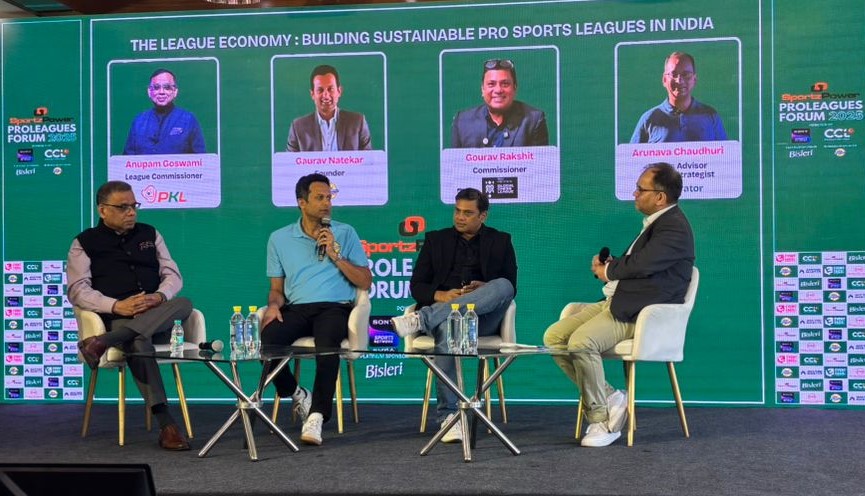
INDIA CONTINUED to strengthen its position as one of the world’s most dynamic sports markets at the SportzPower Pro Leagues Forum 2025, held on Wednesday, December 10, 2025, at Boundary Hall, MCA Recreation Centre, Bandra-Kurla Complex, Mumbai. Leaders from across the professional sports ecosystem came together to discuss the evolving league economy. With marquee properties like the IPL, ISL, PKL and UTT now complemented by emerging leagues in padel, pickleball, kho-kho, esports, and community sports, the forum highlighted how India’s league landscape has become deeper, more diverse, and increasingly investment-ready.
The conference brought together league commissioners, team owners, investors, broadcasters, brands, venue operators, technology innovators and policymakers to examine how India’s professional sports industry could be scaled sustainably.
The event opened with remarks from Deepak Chaudhary, Founder & Managing Director of EVA Live, who noted that the forum represents a new effort by the organisation to build a platform that recognises the achievements of major leagues while also encouraging the development of newer sporting ecosystems across India.
The opening panel ‘The League Economy — Building Sustainable Pro Sports Leagues in India’ focused on one of the central themes of this year’s forum: the economics behind building lasting, commercially viable leagues in India. The MC introduced the session and welcomed the panelists, setting the context for a discussion grounded in practical lessons, operational realities, and future opportunities.
The panel featured:
* Anupam Goswami, League Commissioner, Pro Kabaddi
* Gaurav Natekar, Co-founder, World Pickleball League
* Gourav Rakshit, Commissioner, Tech Mahindra Global Chess League
* Moderator: Arunava Chaudhuri, Sports Advisor & Football Strategist
Throughout the discussion, speakers reflected on what it takes to strengthen India’s league ecosystem—touching upon revenue diversification, media evolution, athlete development, franchise operations, technology integration, governance, and long-term sustainability models.
Anupam Goswami spoke about the evolution of PKL and the importance of nurturing deep fan affinity for Indian-origin sports.
He noted, “Being steadfast is more important than being sustainable—engage your fans and monetize it. Risks and challenges are always going to be there.”
He further emphasized the role of affordability and long-term value creation, adding, “As league managers, our job is to keep player inflation under control. We need to invest in community-based franchises—invest and include—to make the player the legacy asset.”
Gaurav Natekar highlighted the boom in new-age participation sports such as pickleball and the emerging opportunity for structured league formats.
He explained, “It’s always good to start something on a blank slate. The idea came from seeing people build pickleball courts in their own homes. Pickleball is easy, fun, social-media worthy and inclusive of all ages.”
Speaking about the league’s growth potential, he added, “We want to take pickleball to the international level. In Season 1 we had players from 14 countries, and we want more Indian players to come forward and play the sport.”
Gourav Rakshit shared insights on how technology and digital-first audiences are reshaping league formats, using the Global Chess League as an example.
He remarked, “Chess has evolved from being just a cerebral game. Covid activated the trigger for its rise, and the boundaries of possibilities are different now. It’s an individual sport, and we try to make it creative and entertainment-worthy—commentary is a big part of that experience.”
He also stressed India’s expanding global influence: “India will be a big part of the chess league and tournament.”
Moderator Arunava Chaudhuri steered the conversation toward practical approaches for sustainability. Highlighting the importance of attention and engagement, he noted, “Attention span is a key challenge in a league format,” while pushing panellists to consider long-term structures that support franchises, athletes and fan communities alike.
The session concluded with a shared belief that India’s league ecosystem is entering a pivotal decade—one where innovation, strategic investment and thoughtful planning will determine which properties achieve global scale. As established leagues consolidate and new formats emerge, leaders agreed that sustainability will depend on strengthening community engagement, leveraging new media, nurturing home-grown talent, and building legacy-driven models that withstand market cycles.

