


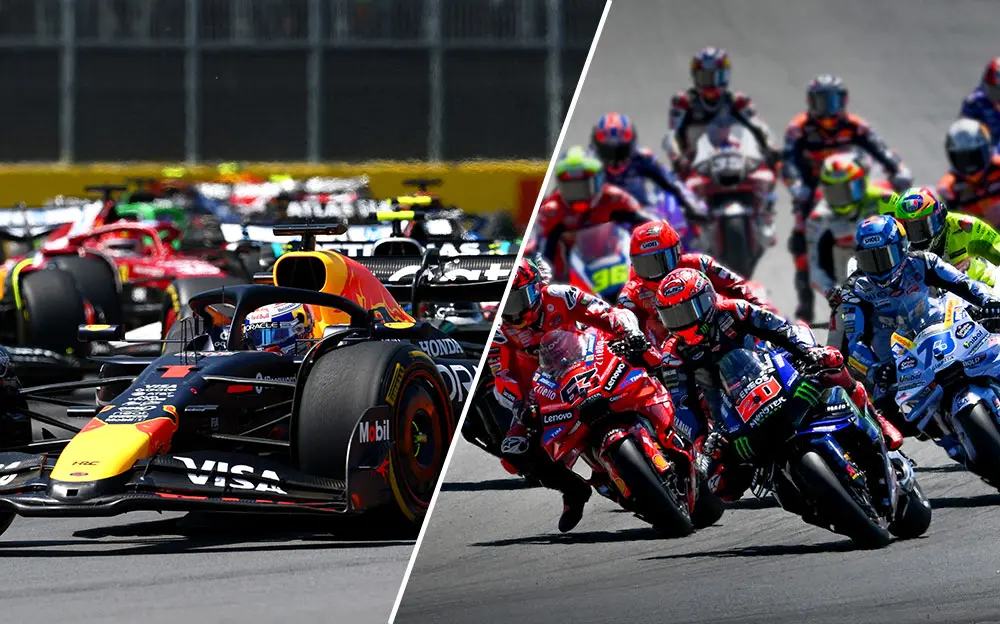
THE ESCALATING CONFLICT in the Middle East, triggered by the US-Israel attack on Iran, is having a cascading impact on major international sporting events in the region, and in the immediate term, motorsport in particular.
While Formula One has confirmed that the Bahrain Grand Prix and Saudi Arabian Grand Prix will not take place in April, MotoGP has declared that Qatar, which was supposed to host the fourth round of the 2026 MotoGP season from April 10–12, is moving its race to later in the year.
F1’s decision was announced ahead of the Chinese Grand Prix, with officials concluding that the risks linked to the ongoing war made it impossible to stage the events safely. While several alternatives were considered, it was ultimately decided that no substitutions will be made in April.
The Formula 2, Formula 3 and F1 ACADEMY rounds will also not take place during their scheduled times. “The decision has been taken in full consultation with the FIA and respective promoters,” a statement issued by F1 reads.
Both F1 races were originally scheduled as early-season rounds of the Formula One World Championship, with Bahrain set to host on April 12 and Saudi Arabia on April 19. However, the United States and Israel’s decision to jointly attack Iran, has led to missile strikes and heightened tensions across the region, creating uncertainty around travel, security, and the movement of equipment required for the championship.
The cancellations leave a five-week gap in the calendar between the Japanese Grand Prix on March 29 and the Miami Grand Prix on May 3. As a result, the 2026 championship schedule is expected to drop from 24 races to 22.
On the MotoGP grid, meanwhile, with the Qatar Grand Prix shifting to November, other events near the end of the season have also been adjusted. The Portuguese Grand Prix will now take place on November 22, while the traditional season finale in Valencia has been moved to November 29 to accommodate the change in the calendar.
MotoGP organisers said they will continue to monitor developments in the region closely, but remain committed to running the race later in the season if conditions permit, ensuring fans still get to witness the high-profile event under safer circumstances.
Commenting on the decision to shelve the Bahrain and Saudi Arabian F1 GPs, Formula 1 president and CEO Stefano Domenicali said: “While this was a difficult decision to take, it is unfortunately the right one at this stage considering the current situation in the Middle East.
“I want to take this opportunity to thank the FIA as well as our incredible promoters for their support and total understanding as they were looking forward to hosting us with their usual energy and passion. We cannot wait to be back with them as soon as the circumstances allow us to do so.”
FIA president Mohammed Ben Sulayem added: “The FIA will always place the safety and wellbeing of our community and colleagues first. After careful consideration, we have taken this decision with that responsibility firmly in mind. We continue to hope for calm, safety and a swift return to stability in the region, and my thoughts remain with all those affected by these recent events.
“Bahrain and Saudi Arabia are incredibly important to the ecosystem of our racing season, and I look forward to returning to both as soon as circumstances allow. My sincere thanks to the promoters, our partners, and our colleagues across the championship for the collaborative and constructive approach that has led to this decision.”
The decisions reflects how the ongoing conflict in the Middle East is beginning to impact global sport. Several major motorsport events in the region have already faced disruption, highlighting the challenges organisers face when geopolitical tensions affect travel, logistics and safety. By postponing rather than cancelling the Qatar race, MotoGP hopes to preserve one of the championship’s most prominent Middle Eastern rounds while allowing time for the situation to stabilise.

