


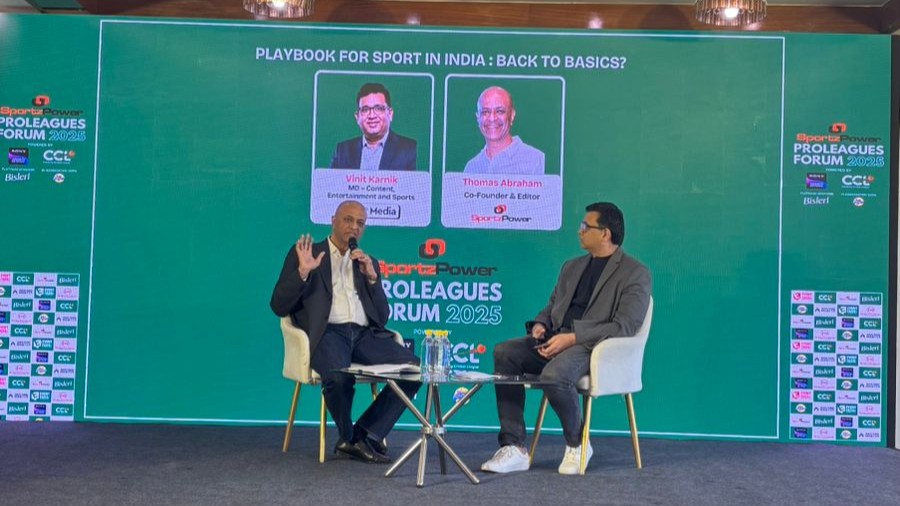
At the SportzPower Pro Leagues Forum 2025, held on Wednesday, December 10, 2025, in Mumbai’s Boundary Hall, MCA Recreation Centre, Bandra-Kurla Complex, industry leaders took a closer look at what it takes to grow sports in India beyond cricket. The fireside chat featuring Vinit Karnik, MD – Content, Entertainment & Sports, and Thomas Abraham, Co-founder & Editor, SportzPower, delved into the commercial realities, talent development, and governance challenges facing emerging sports leagues, offering an insider’s perspective on building sustainable, globally competitive sports properties.
The session explored the commercialisation of sports in India, the opportunities for leagues beyond cricket, and the critical factors necessary for building sustainable and globally competitive sports properties.
Thomas Abraham opened the conversation with a question that set the tone for the discussion: “Leagues outside of cricket — do they need more attention or not? What is the future of sports beyond cricket in India?”
Vinit Karnik reflected on the current state of Indian sports and the commercial dynamics, “Sports are essentially leagues in our country. I heard people being honest with their opinions. Commercialisation of sports in India has increased. The key question is: what’s the appetite or need for a sport when you start making a business out of it? Is there a need for a particular sport to be commercialized? Do we have the right talent in the competitive environment? Is the administration really capable of scaling the game to an international level?”
He added perspective on grassroots participation and social media influence, “Tennis ball cricket was organically conceived as a game, but people were willing to participate and pay money to do so. Social media, talent recognition, and administration all play a role in making a sport visible and viable.”
Karnik also emphasised the importance of persistence and governance, “Going back to the rough and doing it again has to be in demand. People governing sports—the administration—must have a vision. People have accepted IPL because of its execution, but not every other sport can replicate that. Cricket’s proposition is completely different from other sports.”
He spoke about the perspective of franchise owners and the lessons from successful leagues, “Franchise owners signed up after noticing the pay and the potential benefits. Kabaddi is now the second most famous sport today, but it hasn’t reached the level of stardom and fame it deserves. Talent scouting and talent engagement are crucial before starting a league. Cricket’s whole story evolves around regional, national, and international standards. Unless the administration does its work, no other sport in India will have global recognition.”
The discussion underscored the multiple layers necessary for building sustainable sports leagues: talent development, governance, fan engagement, and commercialisation—beyond just replicating cricket’s model.
The fireside chat concluded with a clear message: for India to become a multi-sport nation at a global scale, each sport requires thoughtful planning, structured administration, and an ecosystem that nurtures talent from grassroots to professional levels.

