



That there is an immense concentration of world cricket’s power and money, predominantly within the Indian cricket board (BCCI) and the Indian Premier League (IPL) is a well known reality.
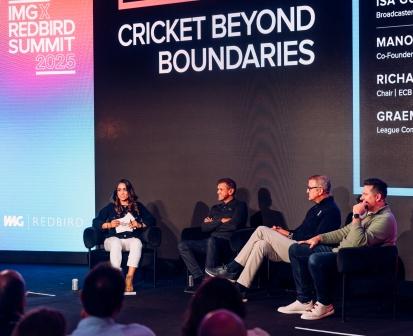
The challenge said reality poses for the future of cricket globally was among the points that Manoj Badale, principal owner of IPL team Rajasthan Royals, brought forth at a panel discussion Wednesday at the ongoing IMG x RedBird Summit taking place at Soho Farmhouse in the Cotswolds, UK.
Badale, who also owns cricket teams in the Caribbean Premier League (Barbados Royals) and South Africa’s SA20 (Paarl Royals), noted that the governance of the game “is incredibly concentrated with” the BCCI, and with one Indian broadcaster – Reliance-controlled JioStar.
Pointing to the influence of BCCI and India on cricket, Badale said: “The game is disproportionately influenced by the Indian eyeball and the Indian diaspora eyeball. The governance of the game is incredibly concentrated with the BCCI. And for those that are not familiar with the BCCI, there’s an almost direct link to the Indian government.
“You’ve also got another issue, which is you’ve got incredible concentration within the media landscape, within cricket. You’ve got Reliance that many people would be familiar with, JioStar, which is about to IPO next year. That’s a merger that just took place. So, you’ve got about 80 to 90% of the eyeballs being controlled by one media company, and you’ve got about 93% of the economics of the game controlled by one governing body.”
When session moderator Isa Guha, sports television commentator and former England cricketer, asked “Is that dangerous?”, Badale responded thus: “Not dangerous. I mean, it definitely poses challenges. I spent 18 years sort of account managing the BCCI, because it’s, you know, we turn over about $90 million and about 60 of that comes from a single cheque from BCCI. So it definitely requires very sort of complex stakeholder management.”
While completing his response, Badale also referenced comments made by co-panelist Richard Thompson, chairman of the England and Wales Cricket Board, who speaking earlier, had said: “…I think in terms of how we in English cricket govern, we govern with a very clear purpose. When I took on the role three years ago, it was a burning platform, and there were a lot of challenges in the game, and I felt cricket didn’t have a North Star. I gave it a North Star by saying I felt it should be the country’s most inclusive sport. …And so for the last three years, we have a five-year plan to become the country’s most inclusive sport, which is a high bar. No governing body has ever claimed to do that or want to do that, but I felt we needed to get out of a comfort zone, push boundaries, change behaviors, change the culture of the way cricket is played and enjoyed, and in a way where the game feels more inclusive and can be enjoyed by everybody.”
About the BCCI and its functioning, Badale further said: “And it’s also an organization, like a lot of governing bodies and a lot of political organizations, that sort of changes color and shape every three or four years. I think it’s dangerous if people have got the same ambitions that Richard just described. You know, if the BCCI has got the same old staff that Richard just described. Barney (Francis, EVP at IMG) made a reference earlier to the criticality of participation at grassroots, which sometimes we forget about, which I thought was a really important point. So it’s dangerous if the North Stars are wrong.”
Investment in The Hundred
On recent investment in English cricket, Thompson noted: “When I came into office, we had an offer of £350 million from Bridgepoint. A number of the counties wanted me to accept the offer. I rejected it and thought that was a leap of faith, because £350 million would wipe the debt out of the whole game. That would have been a seminal moment. But it was at the same time that Lucknow Super Giants had just come into the IPL. And one team in the IPL just sold for $800 million. So, the conversations I had with the chairs was that you’re really valuing the summer, the whole of August, at less than half the price of one team in the IPL. I felt you couldn’t, and you shouldn’t, and I tried the argument hard, and I fortunately won.
“We managed to retain control of the tournament, retain schedule, and still raise a billion for selling the teams, but more so, attracting some of the most extraordinary investors in the world.”
On the importance of The Hundred for the women’s game, Thompson pointed out: “When I was chair of Surrey, I saw The Hundred as a threat. When you become the chair of the governing body, you realise how important it is, particularly for women’s sport. It’s actually the only sport women play on the same day on the same pitch. The final this year, where you see the men and the women play on the same day in front of our Lords pavilion, is extraordinary.”
Thompson also stressed on the on the need to market cricket better in the US: “It’s interesting some of the conversations yesterday (Tuesday) in terms of what cricket has got to do in the US to get noticed. We created a product called Bollywood Hollywood, where there’s going to be a whole series of matches played in a kind of pro-celebrity sense. It’s amazing having conversations with Hugh Jackman and Chris Martin and Ed Sheeran, who are desperate to play. So, we definitely want to bring the celebrity factor to the US to ensure that we get some kind of cut-through. Because as much as the World Cup was a success last year, I don’t think it actually cut through in the US in the way it probably could have done.”
Meanwhile, Graeme Smith, former South African cricketer and now SA20 league commissioner, the third panelist, spoke on player burnout vs player choice in cricket: “For players there’s so much more choice now. When I was playing, I was relying on my federation, I needed to play for my country if I wanted to be successful. Time into my career, IPL started, and that kind of changed the landscape for players into the future. I think outside kind of England, India and Australia, I think free agency and player choice is going to be a big, dramatic push in the game. And going to transform the game. And so, I think players now have more choice than they’ve ever had.”
Guha, on her part pitched for more innovations in cricket broadcast: “From a broadcaster point of view, we’ve heard a lot from broadcasters and different kind of innovative ways of adding AI to what you’re watching and hearing from commentators. But I do think player access is absolutely vital in terms of bringing you closer to the player, and being invested in the player as well. And something that FOX do really well in Australia is player mics, being able to access them. Cricket’s a long day, it’s about seven or eight hours, and to be able to drop down on the spider cam and be able to talk to the players in the middle of the game is incredible.”

