



MUMBAI: In its fourth year now, the Indian Super League is yet to ensnare that demographic so crucial to growing football in India – the youth.
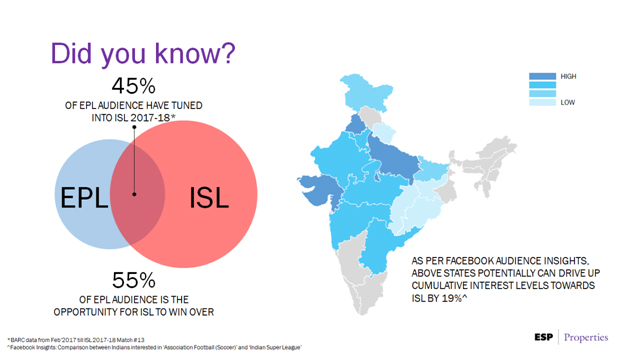
An ESP Properties’ study, presented at the India Football Forum 2017, indicates that approx. 55 per cent of the Premier League viewers in India are not tune into the ISL on television. A lion’s share of this audience is male, aged 4 – 21 years. Culling BARC data from February 2017 to ISL Match 2017-18 match #13, the study indicates that just 45 per cent of the audience that tuned into EPL also viewed ISL matches.
Big data – globally recognised as data sets that are so voluminous and complex that traditional data processing application software are inadequate to deal with them – in India, translates into any data that is available on the sports scene, owing to the sheer size of the country, says Subhamoy Das, ESP Properties senior business director.

The country’s humungous population figures do not lend to easy slicing and dicing, however if game stats, social media data, television data and geographic stats are taken into account. ESP’s analysis of data available throws up interesting statistics.
While the EPL audience in India spans an interesting, advertiser friendly demographic of 4 to 30 year olds, the corresponding statistic for the ISL audience is a demographic that spans the 22 to 50 year olds. Clubs like Atletico Kolkata, FC Goa, Pune City FC and Mumbai City FC have some traction among the 22 to 30 year olds. Others like Kerala Blasters and Chennaiyin FC have the predominantly older age group of 31 to 50 in their fan fold. Unsurprisingly, 55 per cent of the ISL audience is male.
Tracking the fan on social media

For the study, Das mapped Facebook interest levels and found that there is a yawning gap in the number of people interested in football overall versus people interested in the ISL. Football fans in India are not necessarily ‘automatic’ ISL followers. Clearly, there is a need for dedicated effort to convert the potential fans into die hand followers.
“Even if these are tapped, it would be a huge number,” points out Das.
The Facebook Audience Insights show that states like Gujarat, Uttar Pradesh, Punjab and even Rajasthan can potentially drive up cumulative interest levels towards ISL by an impressive 19 per cent. “Right now, mostly operational insights are taken into account while scheduling matches. But such data can help dynamic scheduling of matches on weekends, or having some league matches in cities and states, to pull in a greater audience from states with fan engagement potential,” he says.

The ESP study argues that taken holistically, the data insights from various sources – including social media, TV and ticket sales can be put to better use by the league for dynamic ticket pricing in football priority markets or for targeted franchise marketing efforts in local markets.
Is local market interest related to team performance?
TAM and BARC data show that local market interest in the case of the ISL teams is not always related to the team’s performance on the field. While the NEUFC and KBFC teams on field performance does not appear to affect the local market interest, the DDFC and FCG teams, which boast a high win ratio on the field, do not lure fans into translating the same into local market viewership. For FCPC and MCFC however, higher win ratios appear to drive local market interest in terms of television viewership.

Specifically in case of DDFC and CFC, who boasts of a decent win ratio, the trick to garner greater local market interest is by luring the younger audience to their home matches. The TVR data shows that average TVR in local markets shoots up by six per cent every time the home team wins in the ISL, in the male 4-30 years TG, according to the ESP data. This is an opportunity for these teams.
The study notes that past season TVR data can potentially help schedule matches better and drive TVR up by almost 11 per cent.
Such data, believes Das, can be mined and utilised to mobilise sponsor interest and local market engagement better, with a better understanding of fan behaviour.

